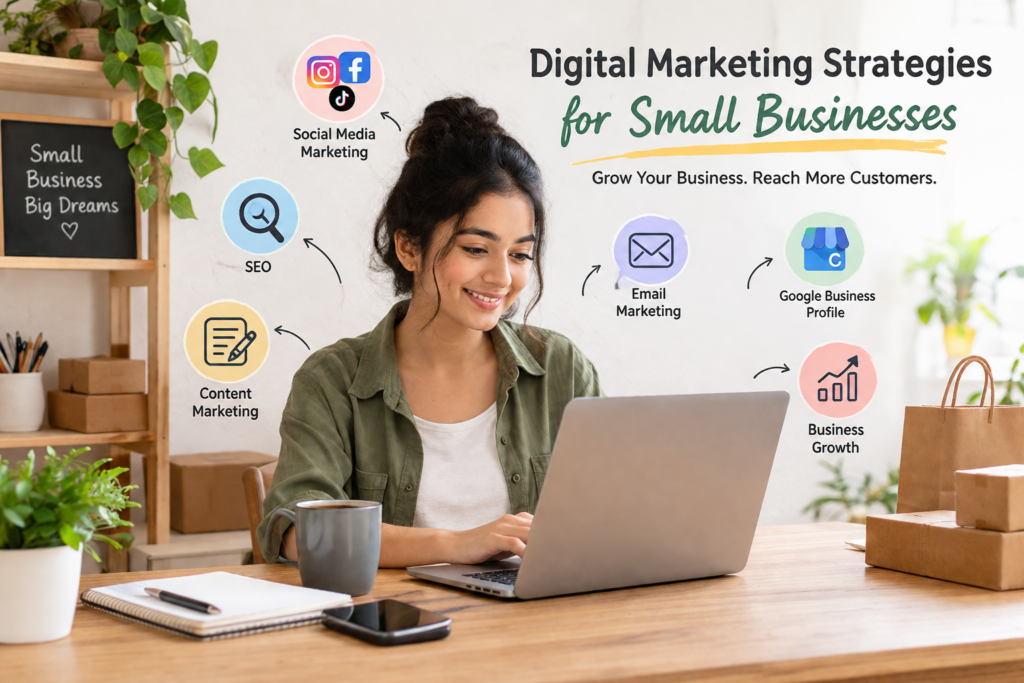
In today’s digital world, having a strong online presence is essential for every business, including small businesses. Customers increasingly use search engines, social media, websites, and online reviews to discover products and services. Digital marketing provides small businesses with affordable and effective ways to reach their target audience, build brand awareness, generate leads, and increase sales. Unlike traditional marketing, digital marketing allows businesses to communicate directly with customers and measure the results of their marketing efforts.
1. Build a Professional Website
A website is one of the most important digital marketing tools for a small business. It acts as an online home for the brand and provides customers with important information about products, services, prices, contact details, and business locations.
A good business website should be simple, mobile-friendly, fast-loading, and easy to navigate. It should also contain clear calls to action, such as “Contact Us,” “Buy Now,” “Book an Appointment,” or “Learn More.” A professional website can increase customer trust and make the business look more credible.
2. Focus on Search Engine Optimization
Search Engine Optimization, commonly known as SEO, helps a website appear higher in search engine results. For small businesses, local SEO can be particularly valuable because it helps attract customers in nearby areas.
Businesses should research keywords that their potential customers use when searching for products or services. These keywords can be included naturally in website pages, blog posts, headings, and descriptions. Creating useful and relevant content regularly can also improve search visibility.
For example, a local bakery could target keywords such as “best bakery near me,” “birthday cakes in Kochi,” or “custom cakes in Kerala.” Good SEO can help businesses attract organic traffic without paying for every website visit.
3. Use Social Media Marketing
Social media platforms such as Instagram, Facebook, YouTube, and LinkedIn provide excellent opportunities for small businesses. Social media helps businesses showcase their products, communicate with customers, and build a strong community around their brand.
Businesses should choose platforms based on where their target audience spends time. For example, Instagram can be useful for fashion, food, beauty, and lifestyle businesses, while LinkedIn can be useful for professional services and B2B companies.
Regularly posting useful and engaging content is more effective than simply promoting products. Businesses can share educational posts, behind-the-scenes content, customer stories, product demonstrations, tips, and short videos.
4. Create Valuable Content
Content marketing is another powerful strategy for small businesses. Instead of focusing only on selling, businesses can create content that solves problems and answers customer questions.
Blog articles, videos, infographics, social media posts, guides, and email newsletters are different types of content businesses can use. Valuable content can establish a business as knowledgeable and trustworthy in its industry.
For example, a skincare business could publish content about skincare routines, product ingredients, and general skincare tips. This type of content can attract people who are interested in the topic and eventually introduce them to the business’s products.
5. Use Google Business Profile
For businesses that serve a particular location, a Google Business Profile is an important digital marketing tool. It helps customers find the business through Google Search and Google Maps.
Businesses should keep their profile updated with the correct name, address, phone number, opening hours, website, photos, and services. Customer reviews are also important because positive reviews can improve trust and influence purchasing decisions.
Small businesses should encourage satisfied customers to leave honest reviews. They should also respond professionally to both positive and negative feedback.
6. Try Email Marketing
Email marketing allows businesses to communicate directly with existing and potential customers. It can be used to share offers, product updates, newsletters, helpful information, and special announcements.
Small businesses can build an email list by offering something valuable, such as a discount, free guide, or useful newsletter. Emails should be relevant and not sent excessively. Personalised and useful emails are more likely to receive attention from customers.
Email marketing can also help businesses maintain relationships with existing customers and encourage repeat purchases.
7. Use Paid Advertising Carefully
Paid digital advertising can help small businesses reach a specific audience quickly. Platforms such as Google Ads and social media advertising allow businesses to target people based on factors such as location, interests, demographics, and search behaviour.
However, small businesses should not spend large amounts without a clear strategy. They can begin with a small budget, test different advertisements, and analyse the results. The best-performing campaigns can then receive more investment.
8. Work With Micro-Influencers
Influencer marketing does not always require working with celebrities. Small businesses can collaborate with micro-influencers who have smaller but highly engaged audiences.
For example, a local clothing brand could collaborate with a fashion creator who has an audience interested in affordable fashion. The influencer can introduce the brand to potential customers in a more personal and relatable way.
Businesses should choose influencers whose audience, values, and content style match their brand.
9. Encourage Customer Reviews and User-Generated Content
Customers often trust other customers’ experiences. Reviews, testimonials, photographs, and videos created by customers can therefore support a business’s digital marketing efforts.
Businesses can encourage customers to share their experiences after purchasing a product or service. With appropriate permission, businesses can feature this content on their website or social media channels.
User-generated content can increase authenticity and help potential customers feel more confident about choosing the brand.
10. Track and Measure Results
One of the biggest advantages of digital marketing is the ability to measure performance. Small businesses should regularly monitor important metrics such as website traffic, social media engagement, leads, conversions, email open rates, and advertising results.
Analytics can show which strategies are working and which need improvement. Businesses can then make decisions based on data rather than assumptions.
For example, if a business discovers that short videos generate more engagement than static posts, it can create more video content. This continuous process of testing, measuring, and improving can make digital marketing more effective.
Conclusion
Digital marketing gives small businesses the opportunity to compete in an increasingly connected marketplace without requiring a huge marketing budget. Building a professional website, using SEO, maintaining social media accounts, creating valuable content, managing a Google Business Profile, using email marketing, experimenting with paid advertising, collaborating with suitable influencers, and collecting customer reviews can all contribute to business growth.
The most important factor is consistency. Small businesses do not need to use every digital marketing channel at once. Instead, they should understand their target audience, select the platforms that best match their goals, create useful content, and regularly measure their results.
With the right strategy and continuous improvement, digital marketing can help a small business increase visibility, attract new customers, build lasting relationships, and achieve sustainable growth.